Saragama Stone Bull Statue
Lazarillo de TormesThe stone bull at the bridge outside Salamanca is more than a carved landmark: it marks the beginning of Lázaro de Tormes’s education in suspicion and self-preservation. The blind man first uses the stone animal to hurt and instruct the boy; later, Lázaro echoes that encounter when he tricks his master into charging a pillar. Across these reversals, stone becomes the fixed instrument around which teacher and pupil exchange violence, knowledge, and power.
Setting and First Encounter
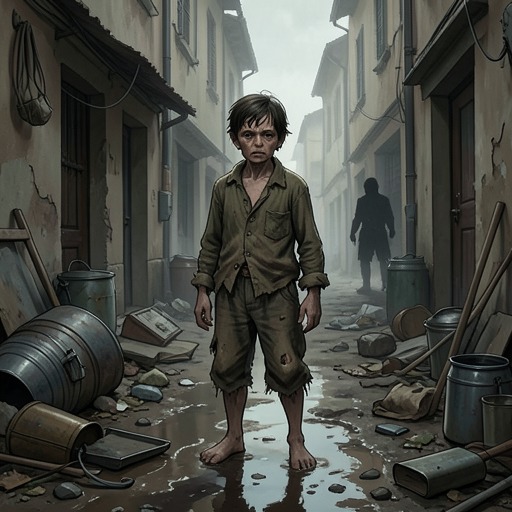
After leaving Salamanca, Lázaro and the blind man reach a bridge whose entrance bears a stone animal almost shaped like a bull. The blind man tells Lázaro to put his ear to it, claiming that the boy will hear a great noise inside. Trusting the instruction, Lázaro brings his head close to the stone. The blind man then strikes him hard against it, leaving him in pain for more than three days.
The prank makes the carved bull a blunt teaching device. The blind man laughs at the trick and tells Lázaro that a servant of a blind man must know more than the devil. The lesson is not simply that the boy has been deceived: he is now dependent on his own alertness in a world where his master’s apparent guidance may conceal a blow. Lázaro understands the encounter as an awakening from childhood innocence and resolves to keep his eyes open, since he is alone and must find a way to survive.
From Landmark to Lesson
The bull’s importance lies in the change it produces in Lázaro, not in any supernatural or hidden property of the sculpture. The promised noise inside the stone is a ruse; what the encounter actually reveals is the gap between the blind man’s words and his purpose. Lázaro’s body learns the lesson before he can put it into practice: his head meets the stone, pain lasts for days, and his account of waking from innocence gives that physical impact a lasting meaning.
The blind man’s instruction also names the unequal terms of their relationship. He offers no gold or silver, but says he can give advice for learning to live. The stone-bull prank demonstrates what such advice entails in practice: knowledge is transmitted through deception and injury, and the pupil must become more watchful than the person who claims to teach him. The sculpture thus anchors a compact initiation scene in which a public landmark becomes part of a private education in distrust.
The Reversal at the Pillar
Much later, during a downpour, the blind man asks Lázaro to position him so he can jump across a stream. Lázaro places him directly in front of a pillar, then jumps behind it and urges him to leap farther. The blind man steps back to gain momentum, charges forward like a goat, and smashes his head against the pillar with such force that he falls backward, nearly dead and with his head broken.
Lázaro’s taunt recalls the earlier trick involving the bull: he asks whether the blind man could smell the sausage but not the pillar, and urges him to smell again. He then leaves the injured man among the crowd gathering to help and runs through the village gate, reaching Torrijos before nightfall. He never learns what became of the blind man and says he did not care to find out.
Narrative Significance
The stone bull and the later pillar form a pattern of repeated bodily lessons, but the balance of power changes. At the bridge, the blind man chooses the deception and delivers the blow; at the pillar, Lázaro uses placement and misleading directions to make his former teacher suffer a comparable collision. The second scene does not take place at the bull itself, yet its staging and taunt recall the first encounter closely enough to make the escape feel like a violent answer to the initiation.
The bull is therefore significant as the starting point of a transformation rather than as an independently developed setting or object. Its solidity makes the blind man’s lesson physically undeniable, while its association with a false promise gives the scene its irony: the boy expects to hear something inside the stone and instead receives a blow from the person beside him. Later, Lázaro turns that learned suspicion into action. The landmark at the bridge stands at the threshold between his former credulity and the wary resourcefulness that enables him to break away.